When you delve into the study of personality, you enter a fascinating realm of psychology that seeks to unravel the complex tapestry of traits that make up who you are. Your personality is the unique pattern of thoughts, feelings, and behaviours that persist over time and across situations, distinguishing you from everyone else. The field of psychology has long been intrigued by what constitutes personality, how it forms, and the ways in which it can be measured.
Understanding the intricacies of personality is not just an academic exercise. It is a journey toward self-discovery that can have profound implications on your life. By gaining insight into your personality, you become better equipped to navigate relationships, choose a fulfilling career, and understand your reactions to the world around you.
The relationship between personality and psychology is symbiotic. As you explore the depths of your own psyche, you contribute to the broader understanding of human nature. The insights gained from such explorations can be transformative, not only for you but also for the field of psychology as a whole.
Importance of understanding your personality
Why should you care about understanding your personality? For starters, it’s the foundation upon which your life is built. Your personality influences every aspect of your existence, from the decisions you make to the way you interact with others. By understanding your personality, you can tailor your life to better suit your needs and desires.
Moreover, self-knowledge is power. When you are aware of your strengths and weaknesses, you can leverage them to your advantage. Knowledge about your personality can guide you in choosing a career path that aligns with your natural inclinations, or it can help you navigate social situations with grace and confidence.
Lastly, understanding your personality is crucial for personal growth. As you become more attuned to your inner workings, you can set goals that are in harmony with your true self. This alignment can lead to a more meaningful and satisfying life, where your actions and choices resonate deeply with who you are.
Defining personality: its core aspects
Personality is often defined by a set of core aspects that, when combined, create a comprehensive picture of an individual’s psychological makeup. The first of these aspects is traits, which are consistent patterns of thoughts, feelings, and behaviours. Think of traits as the building blocks of your personality, the enduring characteristics that you exhibit over time.
The second aspect is motivation, which drives you to act in certain ways. Your motivations are deeply rooted in your values and desires, and they provide the fuel for your behavior. Understanding your motivations can shed light on why you do what you do and what you aim to achieve in life.
Lastly, emotion is a fundamental component of personality. Your emotional responses to various situations reveal a lot about your temperament and how you perceive and interact with the world. Emotions can range from joy to sadness, anger to fear, and understanding your emotional patterns can help you manage your reactions and build healthier relationships.
The role of psychological assessment in understanding personality
Psychological assessment is an invaluable tool in the exploration of personality. It involves the use of scientifically designed tests and procedures to evaluate various aspects of your psychological functioning. Through these assessments, psychologists can gain insights into your character, providing a clearer picture of what makes you tick.
The role of psychological assessment goes beyond mere identification of traits; it helps in diagnosing psychological disorders, guiding therapeutic interventions, and supporting your personal and professional development. A well-conducted assessment can reveal nuances of your personality that might not be immediately apparent, allowing for a deeper understanding of your inner world.
Psychological assessments are also beneficial in organisational settings. They can assist in the selection of candidates who are a good fit for specific roles, or they can help in team-building by understanding the different personalities that make up a workgroup. This understanding can lead to more harmonious and productive work environments.
The process of personality assessment
The process of personality assessment typically begins with a clear understanding of the purpose behind the evaluation. Are you seeking to understand yourself better, or are you preparing for a professional endeavour? Once the goal is established, a psychologist selects appropriate tests and measures to gather information about your personality.
The assessment can include interviews, observations, and standardised tests. Interviews provide a narrative of your life experiences and perceptions, while observations allow the psychologist to see how you interact with your environment. Standardised tests offer a more objective measure of certain personality characteristics, providing a structured way to compare your traits with those of others.
After the data is collected, the psychologist analyses the information to draw conclusions about your personality. This analysis is often a complex process, as it requires the integration of various pieces of information into a coherent whole. The end result is a comprehensive report that outlines your personality profile, offering insights and recommendations based on the findings.
Different methods of personality testing
Personality testing can be achieved through various methods, each with its own strengths and applications. Self-report inventories, such as questionnaires and surveys, are one of the most common methods. They ask you to reflect on your behaviours, feelings, and thoughts, providing a direct window into your psychological world.
Projective tests represent another approach. These tests present you with ambiguous stimuli, such as inkblots or pictures, and ask you to interpret them. Your responses are thought to reveal unconscious aspects of your personality, providing a different perspective on your character.
Behavioural assessments focus on your actions in real or simulated situations. These methods are particularly useful for observing how you interact with others or how you approach problem-solving tasks. By examining your behavior, psychologists can infer certain personality traits that may not be evident through self-report or projective tests.
The significance of personality testing in psychology
Personality testing holds a significant place in the field of psychology. It provides a systematic way to understand the complexities of human behavior and offers a framework for predicting how individuals will react in different situations. This predictive power is invaluable in many contexts, from clinical settings to workplaces and educational environments.
Furthermore, personality testing contributes to the field’s body of knowledge. By collecting data from diverse populations, psychologists can develop theories about personality development and the influence of various factors on personality traits. This research helps to refine existing assessments and develop new ones, advancing the science of psychology.
In clinical psychology, personality testing is essential for diagnosis and treatment planning. It can help identify specific disorders, guide therapeutic interventions, and track progress over time. Without the insights provided by personality testing, treatment would be less targeted and potentially less effective.
How personality tests contribute to self-awareness and personal development
Personality tests are more than just tools for assessment; they are catalysts for self-awareness and personal development. By taking a personality test, you embark on a journey of self-discovery that can lead to transformative growth. The results can help you understand your natural inclinations, strengths, and areas for improvement.
Armed with this knowledge, you can make more informed decisions about your life. You might choose to pursue a career that aligns with your personality traits or work on developing skills that complement your natural tendencies. Understanding your personality can also improve your relationships, as you become more aware of how you relate to others and how you can communicate more effectively.
Personal development is an ongoing process, and personality tests can serve as benchmarks along the way. By periodically reassessing your personality, you can track changes over time and reflect on the growth you’ve achieved. This process can be incredibly rewarding, as you witness the evolution of your personality and the unfolding of your potential.
Exploring popular personality tests and assessments
There are numerous personality tests and assessments available, each designed to explore different facets of your personality. Among the most popular is the Myers-Briggs Type Indicator (MBTI), which categorises individuals into 16 personality types based on preferences in perception and judgment. The MBTI is widely used for personal development and career planning.
Another well-known assessment is the Big Five personality test, also known as the Five-Factor Model. This test evaluates five broad dimensions of personality: openness, conscientiousness, extraversion, agreeableness, and neuroticism. The Big Five is highly regarded for its scientific robustness and has been extensively researched in psychology.
The Minnesota Multiphasic Personality Inventory, Third Edition (MMPI-3) and the Personality Assessment Inventory (PAI) are comprehensive tests primarily used in clinical psychology settings. They assess a wide range of psychological conditions and are considered the most reliable measures for diagnosing mental disorders. The MMPI-3 and the PAI can provide deep insights into an individual’s psychological state and are a cornerstone of psychological assessment.
Conclusion: Embrace your unique personality
As you’ve journeyed through the core aspects of personality, the role of psychological assessment, and the various methods of personality testing, you’ve gained a deeper understanding of what makes you, you. Your personality is a beautiful and intricate mosaic of traits, motivations, and emotions that define your individuality.
Embracing your unique personality is about accepting and celebrating who you are, while also recognising the potential for growth and development. It’s about leveraging your strengths and acknowledging your weaknesses in a way that enriches your life and the lives of those around you.
Remember, the pursuit of self-knowledge is a lifelong endeavour. Continue to explore the fascinating world of personality, and allow your understanding of yourself to evolve. As you do, you’ll find that embracing your unique personality is not just an act of self-acceptance—it’s a journey towards living your most authentic life.
Receive your Personality Assessment Today and embark on the next phase of your self-discovery journey. With the insights gained from a professional assessment, you can unlock the full potential of your personality and chart a course toward personal fulfilment and success. Contact our team to book your personality assessment.
Steps to book your personality assessment
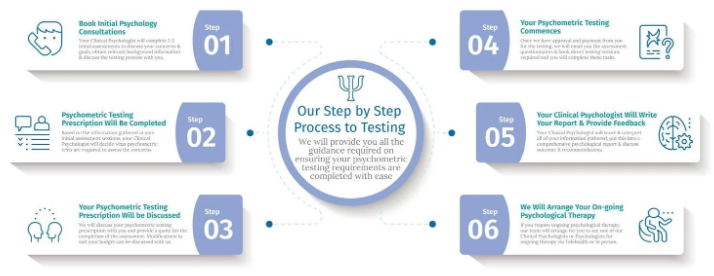
Completing your personality assessment with us is straight forward. Your Clinical Psychologist will conduct information gathering through clinical interview including discussing with you what style of personality assessment you are seeking (e.g., understanding your core personality traits or if you are after a clinical personality assessment of maladaptive personality traits such as is the case with ‘personality disorders’. Your Clinical Psychologist will also gather information about your personality through psychometric tests on personality, then put this all together and provide you with feedback in the form of a report and a feedback session. Contact our team today to find out more about the personality assessment process.