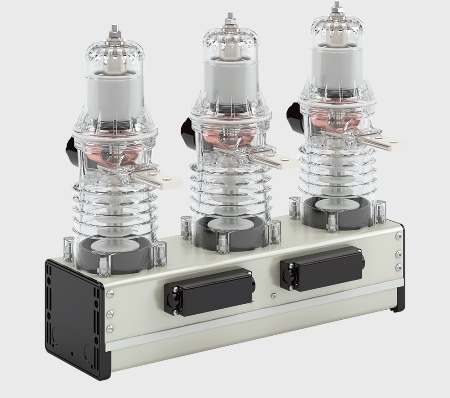
High-voltage vacuum circuit breaker (VCB) is a switching device designed for switching operations (on-off operations) of individual circuits or electrical equipment in normal or emergency modes under manual or automatic control, made for voltage over 1 kV, in which vacuum serves as a medium to extinguish the electric arc.
The first industrial samples of vacuum circuit breakers appeared in the USA and Germany. The founders of their mass production are the companies General Electric (USA) and Siemens (Germany).
In 1990, the company “Tavrida Electric” actively started to create and develop VCB, which today has become one of the world leaders in this field, supplying its products to dozens of countries on all continents.
VCB have now become the world’s predominant switching devices for electrical networks up to 36 kV.
At present, the world has established industrial production of highly reliable fast vacuum circuit breakers capable of disconnecting currents up to 100 kA and operating at voltages up to 84 kV.
The limitation on the operating voltage is due to the need to connect several chambers in series. For example, 220 kV VCB require four 84 kV chambers. There are other difficulties that prevent the creation of a multi-break vacuum circuit breaker.
VCB have now become the world’s predominant switching devices for electrical networks up to 36 kV.
Classification of switches
Switches are subdivided according to the following main characteristics:
- The place of installation;
- The location of the arc-quenching device;
- Constructive connection between the poles;
- Functional connection between the poles;
- The type of drive according to the type of energy;
- The type of drive according to the type of energy used in the operation;
- The nature of the constructive connection between the circuit-breaker and the drive;
- Mechanical resistance: normal and with increased mechanical resistance;
- The suitability of the circuit-breaker for automatic reclosing;
- Purpose: mains; generator; for electro-thermal installations; special purpose.
Time operation – one of the main requirement
Obviously, the main requirement for a switch is its high reliability in all possible modes of operation, which, in turn, depends on many parameters.
Fast operation. Since the short-circuit mode is the most severe, it is necessary to ensure that the circuit is shut down in the shortest possible time. This is especially important for industries such as petrochemical, oil production and refining, metallurgy and, of course, power generation, where continuity of power supply is the first priority. Thus, one of the most important characteristics of a circuit breaker is its own tripping time – the time interval from the moment the trip command is given until the arc-quenching contacts stop touching (opening).
About the Author
Marvin B. Seibold electrical engineer Tavrida Electric company with over 10 years of experience in maintaining, and repairing high and medium voltage power equipment. You can reach us through our website https://www.tavrida.com/tena/ where you will find our phone number, email address, and online contact form.