The Internet of Things (IoT)) has been growing immensely over the last couple of years. It helps us connect with numerous physical objectives simultaneously and helps us collect numerous pieces of data in one go. Many business units are adopting this new technology to reach great heights.
And also, IoT is the future, so why should manufacturing sectors be left behind? When this smart application, which is IoT, is used in an industrial context, it is referred to as IIoT.
IIoT can be considered one step in converting the traditional process into a smart automation process with the help of the internet of things.
Let’s now understand in detail the IIoT and its usage in the manufacturing sector.
What is IIoT
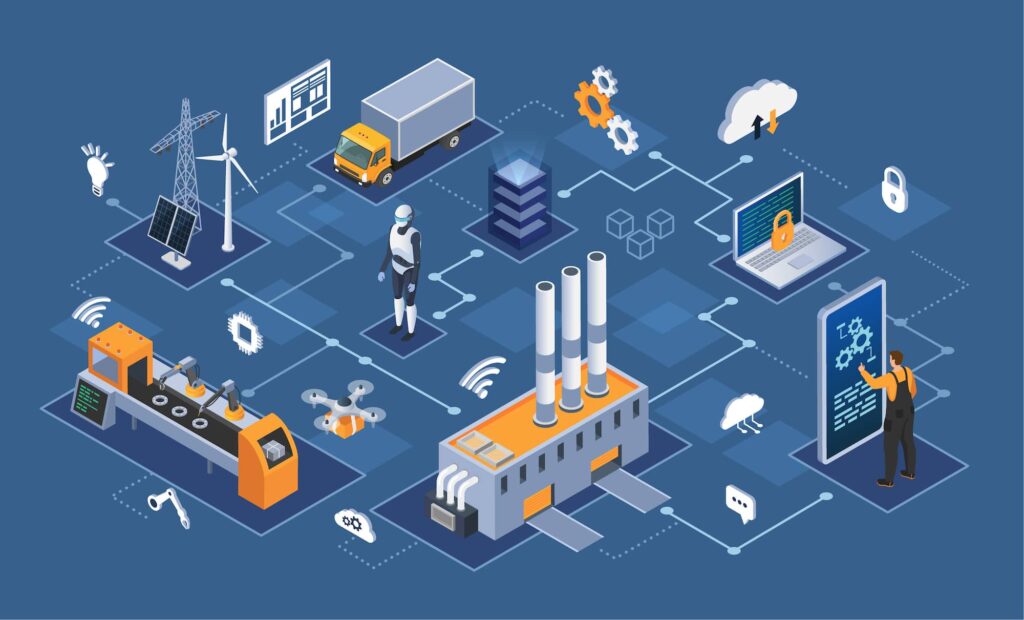
The industrial Internet of Things ( IIoT ) is a set of technologies and a network of intelligent devices which help in monitoring, communicating, and collecting data without the help of human involvement. It eliminates manual processes and improves business efficiency.
We can also say that when IoT capabilities and usage are implemented in industrial and manufacturing space it is known as industrial IoT.
IIoT is an amalgamation of technologies like data analytics, big data, machine learning, AI, sensors data, cloud computing, cyber security etc thus serving all the facilities to manufacturers in one plate which help in improving productivity and efficiency of business.
Now if Erp which is a popular and traditional application that is used by let’s say each and every manufacturing unit does not need any introduction, now with ERP and IIoT integration manufacturing unit can make the whole process SMART and help in deriving actionable insights from this integration.
Let’s discuss the benefits of IIoT and ERP integration.
Benefits of IIoT and ERP integration
1. Increase in efficiency
One of the winning features of integration of IIOT with ERP systems in the manufacturing industry is increases in efficiency and productivity.
This integration helps in maintaining various operations of manufacturing departments like
- Inventory management
- Production count
- Re-ordering process
- Equipment updating
- Enterprise asset management
- Energy consumption
Apart from the above IIoT solutions also help manufacturers to have a deep insight into the cost prevailing in the market, energy efficiency and carbon footprint matrix, etc.
Moreover, IIoT and ERP integration help in automating all the processes which helps in improving productivity, improve time management, etc which leads to an increase in production and improved profitability.
2. Predictive analysis
One of the significant use of IIoT and ERP integration is to move from reactive mode to predictive mode. The IIoT algorithm based on historical data and historical patterns helps to make predictions and helps manufacturers to determine upcoming trends and increases in seasonal and regional demand.
Not only this the sensors embedded in Equipment and machines or on the plant floor help in picking up problems prior to any disruption in the process.
This smart predictive maintenance help the manufacturing sector in improving integration and coordination which help to keep your production line smooth and flexible and meanwhile also helps manufacturers to analyze downtime if any.
3. Real-time data analysis
As we discussed above with the help of multiple sensors on machines and equipment the ERP solutions help in providing real-time data analysis, and help manufacturers in preparing a real-time report which helps them to diagnose and learn about any flaw in terms of quality. IIoT and ERP ecosystem help manufacturers in generating real-time performance report and warehouse management report with just one click.
4. Cut down cost
The coordination of IIoT and ERP will definitely help manufacturing units to cut down its cost as the predictive analysis benefit help in troubleshooting the pending issue and help in analyzing any upcoming tragedy.
This forecast helps in reducing maintenance and operational costs as the manufacturers are ready with remedies.
Moreover, with the help of IIoT, manufacturers can also examine the usage of energy which allows manufacturers to monitor power usage and consumption more carefully.
5. Quality control
By integrating IIoT with ERP the censor embedded with ERP helps in improving scalability, workflow, and quality metrics.
These sensors help in identifying any fallout in the manufacturing process at the operation stage only. It also helps in detecting any fault in the quality of goods which can be fixed at the initial stage.
6. Supply chain
IIoT and ERP Help businesses in planning,
Implementing and adapting the decision smoothly and quickly.
Due to this smart integration, there is clear visibility and transparency about incoming and outgoing components which helps in improving coordination between other departments of the business and in turn drives more effective purchasing operations.
7. Asset tracking
IIoT-connected sensors can help manufacturers trace the products from start to end and alert manufacturers if there is any damage to the goods.
With this facility, manufacturers can also track stolen or lost assets. Moreover with IIoT integration manufacturers can now check on the temperature, humidity, and weight of the components in real time with just one click.
8. Item identification
The IIoT and ERP help with item identification efficiency with the help of GPS and RFID.The history of each item can be identified with the help of the above tools.
Moreover, with the help of RFID application various manufacturing operations, raw material procurement, work in progress, finished goods and lastly packaging of materials at each stage will be identified and examined.
This facility helps manufacturers to have real-time information about each component and simultaneously helps in improving quality leads also.
9. Improve safety security
Combining IIOT with ERP helps in improving staff safety and security with IIoT, workers can now trace the movement of risky components or can keep an eye on risky manufacturing activities smoothly.
Manufacturers can have a full view of the working of various operations which help in identifying any security breach easily.
For eg – leakage of oil from any pipe and also loss or theft of any hazardous components, etc can be traced and worked on.
Bottom line
So you are convinced that IIoT and ERP integration are the future of the manufacturing industry, so what are you waiting for?
Get in touch with our experts at Silent Infotech only and check out our RFID IoT gateway tool to seamlessly adopt and implement this new technology in your manufacturing unit.