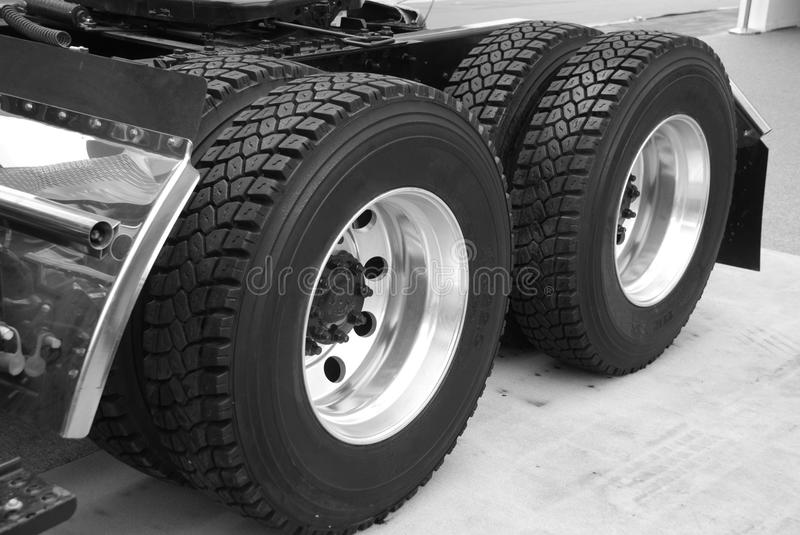
There are no clear signs that trailer tires with a tread depth of 1.6 mm have poorer grip than brand new tires. Rather, the grip is better with worn tires. This is how the recently completed ice tests at VTI in Linköping are summarized.
The assignment for VTI was to investigate whether there is reason to increase the tread depth requirement for trailer tires for heavy vehicles. The short conclusion is that it does not exist, says the Swedish Transport Agency’s investigator Hans Norén, who is surprised by the results.
– I thought that smaller tread depths would automatically mean worse grip. That is why we at the Swedish Transport Agency ordered the tests to see if we would propose a change in the tread depth on the trailer tires, at the same time as the new winter tire law for heavy vehicles enters into force on 1 June this year, he says.
The reason why worn Truck tyres get a better grip is believed to be that the contact surface between the tire and the road becomes wider when the pattern decreases.
For steering and drive axles, the requirement for tread depth is 5 mm, while the requirement for tires for axles on a trailer is 1.6 mm and will remain so after the test results from VTI, the Swedish Road and Transport Research Institute.
Four different tire brands in the dimensions 385/55-R22.5 and 385/65-R22.5 were selected and completely new tires and tread depths of 5, 3 and 1.6 mm were tested. All tires were classified as winter tires.
A tire protruded
It was the braking and steering properties of the tires on ice that were examined through five different grip-related properties.
– When it comes to ice grip (slippery, smooth ice), we see no unambiguous signs that 1.6 mm tread depth generally gives worse grip than on new tires. However, there are mixed results between different tire models and we would need more to arrive at a safer result, says VTI’s project manager Mattias Hjort.
Was there anything that stood out in your tests?
– One of the tires showed clearly deteriorated grip when it is worn to 1.6 mm compared to a new one of the same make.
What could it be due to?
– Because we used naturally worn tires, this particular tire may have happened to something we do not know. Or it could be the construction with construction and rubber compound that made it deviate.
However, one property became significantly worse with reduced tread depth for all tested tires, brake with locked wheels. Compared to a new tire, the friction at 1.6 mm decreases by 20 to 50 percent.
– But with today’s ABS brakes, it is only a short time that the brakes lock completely so we do not see it as a big danger, says Hans Norén.
Mixed results
The steering tests showed generally improved friction values for tires worn to 5 or 3 mm tread depth compared to new ones. When the tread depth decreased to 1.6 mm, the performance decreased compared to 5 or 3 mm in the steering test.
– How the performance for 1.6 mm relates to new tires is not obvious based on the results, which differ between the tires. It is not possible to conclude from this study that worn Truck tyres generally have poorer steering characteristics than new ones, says Mattias Hjort.
Would the results have been approximately the same if the tests had been performed with snow and mud as a basis?
– It is conceivable that the results would have been different and that is something we might look at.
Hans Norén does not think that for trailers it would differ so much with these conditions compared to ice.
– Since both the car’s drive axle and boogie axle flattened to the snow when the trailer arrives, it is a hard surface it rolls on that can be equated with the ice surface on which the tests were performed.
Both Mattias Hjort and Hans Norén would like to thank the tire industry, which at short notice was able to provide 16 different tires so that the test could be carried out.
These tires were included in the ice test:
Good Year Ultra Grip WTS.
Bridgestone M748.
Continental HSW2
Michelin XFN2
This is how the test went:
tests were performed on an ice rink in VTI’s test facility in Linköping with temperature conditions minus three degrees. The tires were mounted in a test rig on a movable ice-covered steel beam and rolled at a speed of 30 km / h. By braking and steering the tire, it was possible to measure the frictional forces that are generated and which form the basis for the evaluation.
All tires, new and worn, were mounted on a truck and driven in 200 km before the tests were carried out. Run-in of the worn tires was carried out in order to recondition the surface which may have become somewhat hard during prolonged storage. The new tires were run in to remove the film of wax found on new tires as a result of the compression molding during manufacture.